Nov 10, 2026 · 6 min read
Claude Certification Roadmap: The Four Exams
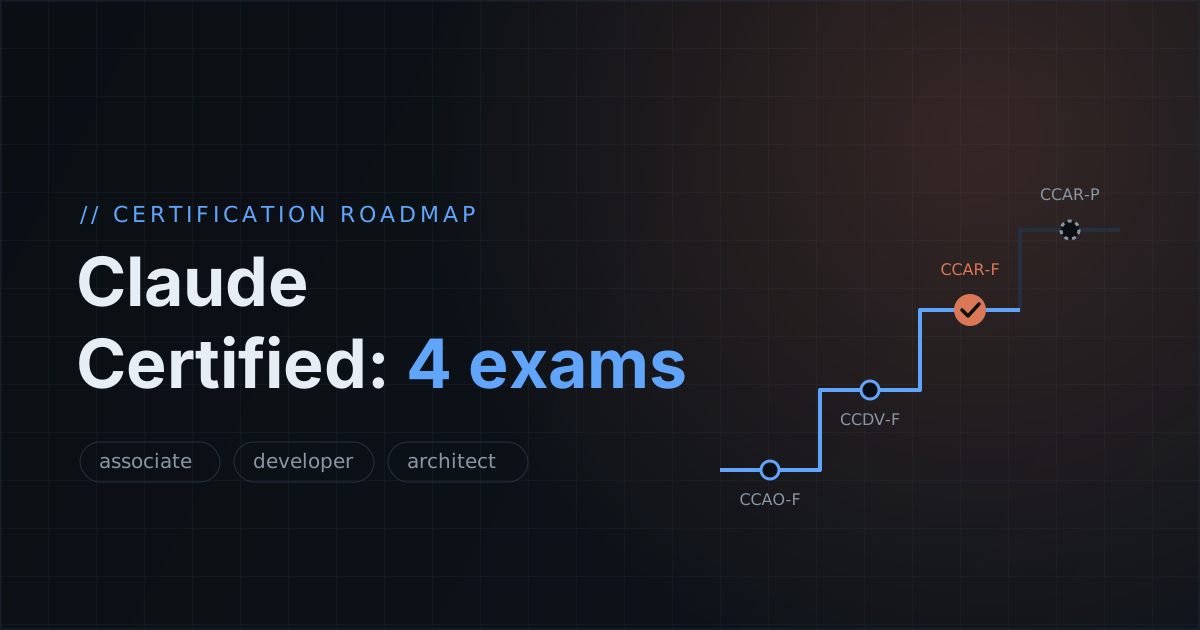
On 10 November 2026 I passed Claude Certified Architect – Foundations (CCAR-F). While preparing I found plenty of guides that disagreed with each other on prices, codes and rules, so this post sticks to what Anthropic's own exam guide and certification FAQ say, as of November 2026.
It covers the four exams, who each one is for, what the Architect – Foundations exam tests, and the path that got me there.
The four exams
Anthropic's programme has three roles: Associate, Developer and Architect. The Architect role comes at two levels, which makes four exams in total.
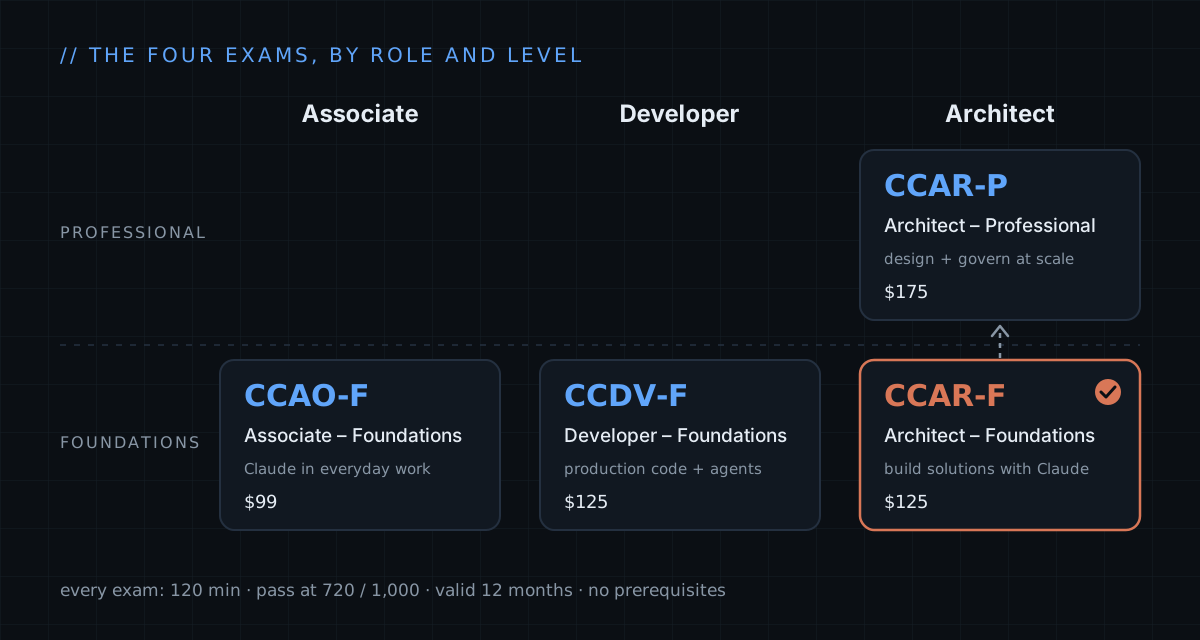
| Exam | Code | Fee (USD) | Aimed at |
|---|---|---|---|
| Associate – Foundations | CCAO-F |
$99 | People who use Claude in everyday business work |
| Developer – Foundations | CCDV-F |
$125 | Engineers who write production code and build agents |
| Architect – Foundations | CCAR-F |
$125 | Architects who design and build solutions with Claude |
| Architect – Professional | CCAR-P |
$175 | Architects who design and govern Claude systems at enterprise scale |
Some rules are the same for all four:
- Time: 120 minutes, with about 135 minutes of total seat time.
- Scoring: a scaled score from 100 to 1,000, with 720 to pass.
- Delivery: proctored by Pearson VUE, either online or at a test centre.
- Languages: English and Japanese.
- Validity: 12 months from the day you earn it.
- Badge: issued through Credly, where anyone can verify it.
Who can take them
This is the part most guides skip. Certification is currently open only to people at organisations in the Claude Partner Network. Registration needs a partner email on a company domain, and a personal address will not work. You also need to be 18 or older.
If your employer is not a partner, you cannot sit the exams today. The free Anthropic courses are still open to everyone, and they are worth doing either way.
Which one is for you
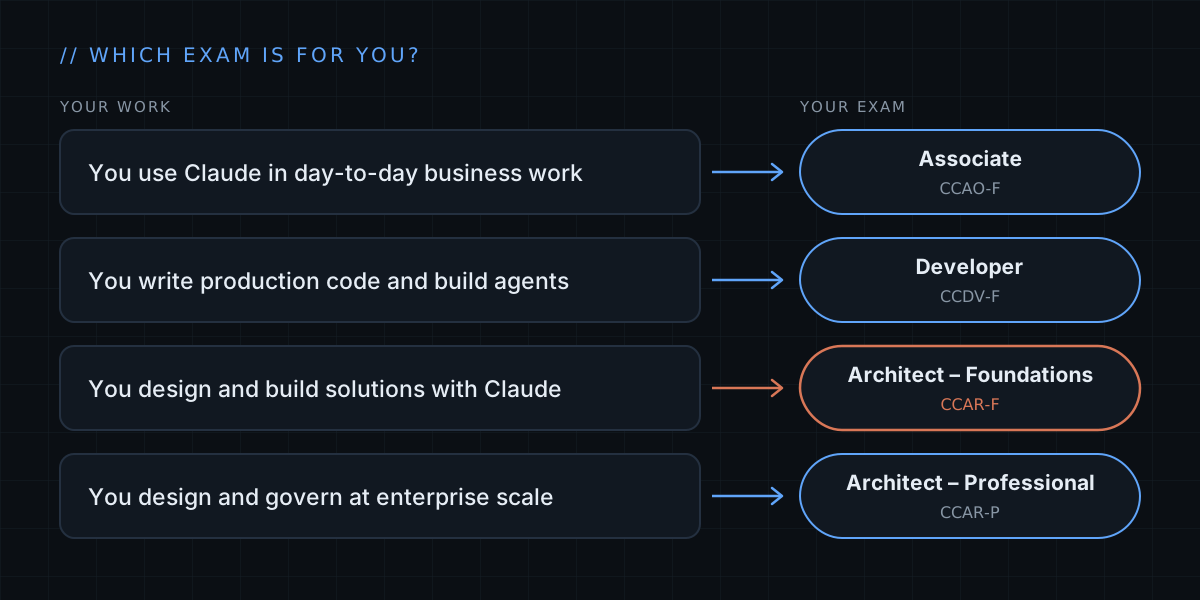
- Associate suits people already using AI tools in roles such as operations, marketing and project management. Its prep course covers prompting, checking Claude's output, fitting Claude into a workflow, and responsible use. It is the only one of the four that does not count toward an organisation's partner standing.
- Developer is for the hands-on builder: production prompting, agents and tool use, Claude Code and MCP, evals and security.
- Architect – Foundations proves you can build with Claude and make sound trade-offs while doing it. It spans Claude Code, the Claude Agent SDK, the Claude API and MCP.
- Architect – Professional is about designing and governing Claude solutions at enterprise scale: enterprise integration, risk and safety, and working with stakeholders.
There is no prerequisite chain. Anthropic calls Foundations "the natural place to start", but you can take Professional without it, and Foundations does not upgrade to Professional automatically.
What CCAR-F actually tests
The exam has 60 questions, multiple choice and multiple response. They are grouped into scenarios: you get four, picked at random from a bank of six.
| Domain | Weight |
|---|---|
| Agentic Architecture & Orchestration | 27% |
| Claude Code Configuration & Workflows | 20% |
| Prompt Engineering & Structured Output | 20% |
| Tool Design & MCP Integration | 18% |
| Context Management & Reliability | 15% |
The six scenarios are a customer support resolution agent, code generation with Claude Code, a multi-agent research system, developer productivity tooling, Claude Code in a CI/CD pipeline, and structured data extraction.
The guide describes the ideal candidate as a solution architect with six months or more of hands-on experience across the Claude API, the Agent SDK, Claude Code and MCP. The questions match that description. They ask what you would do in a production situation: when to escalate to a human, how to pass context to a subagent, where a rule belongs in a CLAUDE.md hierarchy.
The guide also lists what is not on the exam, which saves study time: fine-tuning, billing and account management, cloud provider configuration, computer use, vision, streaming, and tokenisation details.
Renewals and retakes
- Renewal: before the 12 months are up, you review what has changed and take a free, non-proctored assessment. If the certification lapses, you retake the full exam at the full fee.
- Retakes: you wait 14 days after a first attempt, 30 after a second and 90 after a third, with at most four attempts per exam in any rolling 12 months. Each retake costs the full fee.
- Content updates: the Associate, Developer and Architect – Professional exams get updated content on 7 December 2026, with new exam guides due on 17 November. Check the guide version before you book.
How I got there
My path had four parts, and the exam drew on all of them.
- Course work. I worked through Anthropic's courses first. The ones I completed are on my certifications page.
- A year and a half of daily use. I have been working with Claude for about 18 months. That is where the judgment about what it does well, and where it needs checking, comes from.
- Building applications on the Claude API. Tool use, structured output and context management stop being abstract once you have shipped them.
- Running my own agent team. I have a named agent and custom subagent teams that do work for me. They run on my home server around the clock, and I use remote control to monitor them and answer their questions. I wrote about the delegation side of this in Claude Agent vs. Subagents.
The largest domain on the exam is agentic architecture, and that fourth point is exactly that domain in practice.
A suggested order
The exam guide's own advice is to build, and I agree with it:
- Take the free courses for the vocabulary: Claude 101, Building with the Claude API, Claude Code in Action, and Introduction to Model Context Protocol.
- Build one agent with the Agent SDK, with tool calls, error handling and at least one subagent.
- Configure Claude Code for a real project: a
CLAUDE.mdhierarchy, path-specific rules, a custom skill, and one MCP server. - Read the official exam guide in full, including the sample questions, then book.
Sources
Rules and prices change, so check the official pages before you register: